
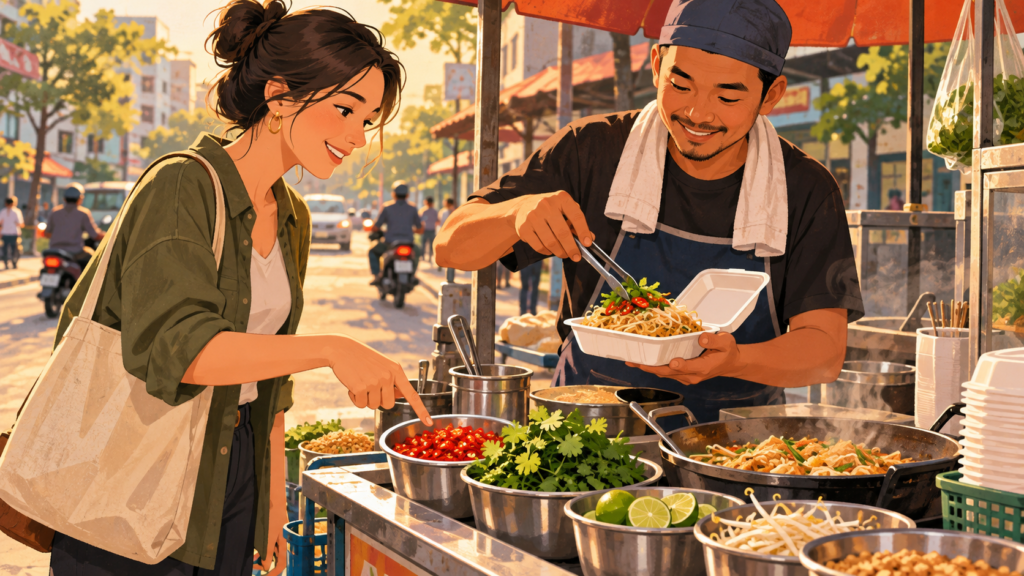
To order street food in Thailand, you can place a complete request by pairing the dish name with kho (ขอ, "may I have") or ao (เอา, "I will take") and attaching your preferred spice level. For example, saying kho phat kraphao moo, phet noi khrap (ขอผัดกะเพราหมู เผ็ดน้อย ครับ) translates to "I'll have pork holy basil stir-fry, a little spicy, please."
Thai street vendors move quickly and prepare meals fresh to order. Understanding how to structure a basic request, add toppings, and answer common questions like whether you are eating at the stall or taking the food to go will help you get exactly what you want.
Polite Ending Particles: Khrap and Kha
In Thai conversation, politeness is conveyed by adding a gender-specific particle to the end of your sentences:
- Khrap (ครับ): Used by male speakers.
- Kha (ค่ะ): Used by female speakers for statements.
- Kha? (คะ): Used by female speakers when asking a question.
Using these particles instantly makes your request polite and natural.
Step 1: Naming Your Dish
When you approach a food cart or market stall, start your order with one of two practical opening words:
- Kho… (ขอ…): "May I have…" (polite and friendly).
- Ao… (เอา…): "I will take…" (direct and common at informal carts).
Combine your chosen opening word with popular street food dishes:
- Khao phat gai (ข้าวผัดไก่): Chicken fried rice.
- Phat kraphao moo (ผัดกะเพราหมู): Stir-fried pork with holy basil.
- Pad Thai gung (ผัดไทยกุ้ง): Pad Thai with prawns.
- Khao man gai (ข้าวมันไก่): Steamed chicken over seasoned rice.
For example, a female speaker ordering chicken fried rice would say kho khao phat gai kha (ขอข้าวผัดไก่ค่ะ).
Step 2: Specifying Spice and Customizations
Standard spice levels at Thai stalls are often hotter than what is served in western restaurants. Vendors expect customers to clarify how much chili they want:
- Mai phet (ไม่เผ็ด): Not spicy (no fresh chilies added).
- Phet noi (เผ็ดน้อย): A little spicy (usually 1 small chili).
- Phet mak (เผ็ดมาก): Very spicy.
- Mai sai prik (ไม่ใส่พริก): Do not add chilies.
You can also customize toppings and portion sizes:
- Sai khai dao (ใส่ไข่ดาว): Add a fried egg on top.
- Phi-set (พิเศษ): Special / extra-large portion (usually costs 5 to 10 baht more).
- Thamma-da (ธรรมดา): Regular portion size.
- Mai sai phong churot (ไม่ใส่ผงชูรส): No MSG.
Step 3: Clarifying Where You Will Eat
Street stalls usually ask if you are staying or taking your meal to go. Listen for these phrases:
- Kin thii nii (กินที่นี่): Eat here.
- Klap baan (กลับบ้าน) or sai thung (ใส่ถุง): Take home / put in a bag.
If the vendor asks kin thii nii rue klap baan? (กินที่นี่หรือกลับบ้าน?), simply respond with kin thii nii khrap/kha or klap baan khrap/kha.
Example Ordering Dialogue
Here is a typical exchange between a customer and a street stall vendor:
Vendor: Khin thii nii rue klap baan khrap? (กินที่นี่หรือกลับบ้านครับ?) — Eat here or take home?
Customer: Kin thii nii khrap. Ao phat kraphao moo, phet noi, sai khai dao duai khrap. (กินที่นี่ครับ เอาผัดกะเพราหมู เผ็ดน้อย ใส่ไข่ดาวด้วยครับ) — Eat here, please. I'll take pork holy basil, a little spicy, with a fried egg too, please.
Vendor: Dai khrap. Thamma-da rue phi-set khrap? (ได้ครับ ธรรมดาหรือพิเศษครับ?) — Got it. Regular or extra size?
Customer: Thamma-da khrap. Thao rai khrap? (ธรรมดาครับ เท่าไหร่ครับ?) — Regular, please. How much is it?
Vendor: Ha-sip baht khrap. (50 บาทครับ) — 50 baht, please.
Customer: Khep tang duai khrap. (เก็บตังค์ด้วยครับ) — Here is the payment / check, please.
What to Say When You Do Not Understand
If a vendor speaks too quickly or asks a question you do not recognize, use these helpful recovery phrases:
- Phoot chaa-chaa noi khrap/kha (พูดช้าๆ หน่อยครับ/ค่ะ): Please speak a little slower.
- Arai na khrap/kha? (อะไรนะครับ/คะ?): Pardon? / What was that?
Practical Practice Scenario
Imagine you are at a local night market in Chiang Mai ordering chicken fried rice to take back to your hotel. You want an extra-large portion, a fried egg on top, and no spice.
Try building your sentence out loud before reading the correct response below.
Answer: Klap baan kha. Ao khao phat gai, phi-set, mai phet, sai khai dao duai kha. (กลับบ้านค่ะ เอาข้าวผัดไก่ พิเศษ ไม่เผ็ด ใส่ไข่ดาวด้วยค่ะ)
Next Steps in Thai
If you are building your everyday conversational confidence in Thai, explore our Thai language resources to practice more practical scenarios. When you are ready to expand your real-world speaking skills, register your interest with PulseLingo to get tailored practice tools.
Sources
- Thai Street Food: How to Order Like a Local (with Phrases) — Ordering street food phrases in Thai, including dish requests, spice levels, egg toppings, portion sizes, and takeaway options.
- How to Order Food in Thai – Phrases, Etiquette, and Tips — Thai food customization phrases such as mai phet (not spicy), phet noi (a little spicy), mai sai (without), and polite ending particles.
- Thai Restaurant Phrases — Phrases for asking the bill (gep ngern duay) and adjusting food options in Thai dining.