
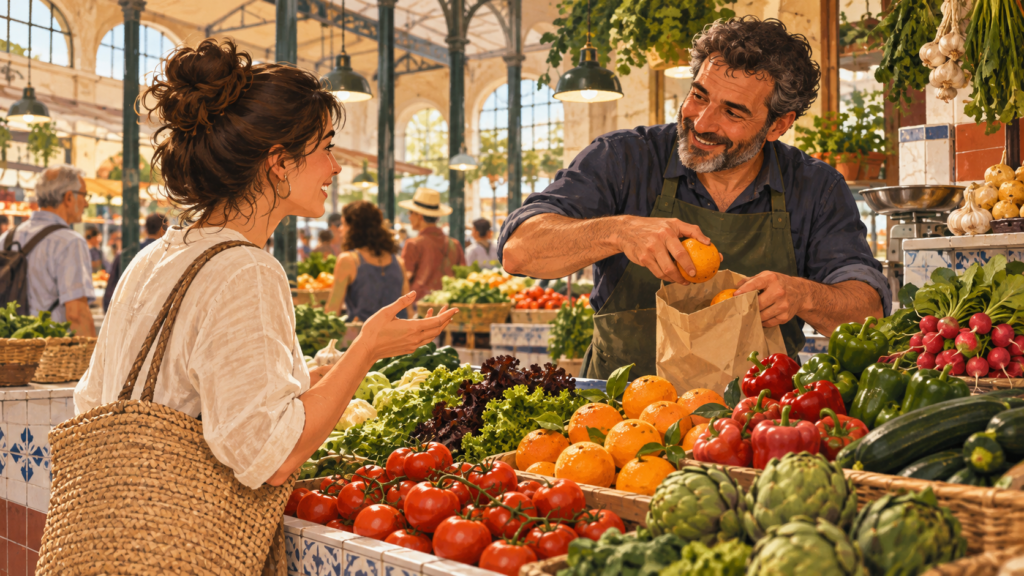
To order fresh produce or groceries at a traditional neighborhood market in Spain, you first secure your spot in line by asking "¿Quién es el último?" (Who is the last person?) or "¿Quién da la vez?" (Who is giving the turn?). Once it is your turn at the counter, ask for items by metric weight using "Ponme…" (Put me…) or "Quería…" (I would like…) followed by the exact quantity, such as "medio kilo de tomates" (half a kilo of tomatoes).
Finding Your Place in Line: The System of "La Vez"
In Spanish neighborhood markets (mercados de abastos) and independent produce shops (fruterías), there are rarely physical queue barriers or numbered paper tickets. Instead, customers rely on a social queuing system known as la vez.
When you approach a busy market stall, announce yourself politely to the waiting crowd:
- "¿Quién es el último?" (Who is the last person?)
- "¿Quién da la vez?" (Who gives the turn?)
One of the customers will respond "Yo" (Me) or raise a hand. That person is your reference point. You now know that your turn comes immediately after theirs. When a new customer arrives later, they will ask the same question, and you simply answer "Yo" to acknowledge that they follow you.
Ordering Produce by Weight and Quantity
In Spain, fresh food is sold using the metric system. Rather than asking for items by the pound, you request them by kilograms, grams, or individual units.
Here are the most common weight phrasing structures used at produce counters:
- Un kilo de… (1 kilogram / ~2.2 lbs): Ponme un kilo de manzanas, por favor. (Give me a kilo of apples, please.)
- Medio kilo de… (500 grams / ~1.1 lbs): Quería medio kilo de tomates. (I would like half a kilo of tomatoes.)
- Un cuarto de kilo de… or Un cuarto de… (250 grams): Dame un cuarto de fresas. (Give me 250 grams of strawberries.)
- Gramos: Ponme doscientos gramos de aceitunas. (Give me 200 grams of olives.)
If you only want a few specific items, order by piece:
- "Ponme tres limones y un melón." (Give me three lemons and a melon.)
To start your order naturally, use flexible verb options like "Ponme…" (Put me…), "Dame…" (Give me…), or the slightly more polite "Quería…" (I would like…).
Selecting Produce: Self-Service vs. Vendor-Served Stalls
At traditional stalls (puestos), customer interaction depends on shop custom. In many traditional shops, you should not touch the displayed produce yourself; the vendor selects and bags everything for you. Look for signs or watch other customers. If plastic bags and disposable gloves are visibly set out, self-service is expected. Otherwise, wait for the vendor to select items for you.
You can guide the vendor's choices with simple descriptive requests:
- "Que no estén muy maduros." (Not too ripe.)
- "Para comer hoy." (To eat today.)
- "Un poco más verdes, por favor." (A bit greener/less ripe, please.)
Example Market Exchange
The following example dialogue shows how a typical market interaction unfolds at a Spanish produce counter:
Vendor: ¿Quién da la vez? (Who's next?) You: Yo. Buenos días. Ponme un kilo de plátanos y medio kilo de tomates, por favor. (Me. Good morning. Give me a kilo of bananas and half a kilo of tomatoes, please.) Vendor: Marchando. ¿Te pongo algo más? (Coming right up. Shall I get you anything else?) You: Sí, quería un cuarto de kilo de fresas. Que no estén muy maduras. (Yes, I would like 250 grams of strawberries. Not too ripe.) Vendor: Aquí tienes. ¿Nada más? (Here you go. Anything else?) You: Nada más. ¿Cuánto es? (Nothing else. How much is it?) Vendor: Son seis euros con cincuenta. (That's six euros fifty.) You: Aquí tiene. Muchas gracias. (Here you go. Thank you very much.)
Managing Fast Speech at the Counter
Market vendors work quickly and frequently use colloquial check-ins like "¿Qué te pongo?" (What can I get you?) or "¿Algo más?" (Anything else?). If you do not understand a price or a fast question, stay calm and use a clear recovery phrase:
- "¿Puede repetir, por favor?" (Can you repeat, please?)
- "Más despacio, por favor." (Slower, please.)
- "¿Cuánto es en total?" (How much is it in total?)
Test Your Market Readiness
Before heading to a local market, try answering these three practical check questions without referencing the text above:
- What question do you ask to find your place in an informal market line?
- How do you ask for half a kilo of tomatoes using polite everyday Spanish?
- What phrase do you use if you want fruit that is not yet fully ripe?
Check your answers:
- ¿Quién es el último? or ¿Quién da la vez?
- Quería medio kilo de tomates, por favor. or Ponme medio kilo de tomates, por favor.
- Que no estén muy maduros.
Taking Your Next Step
Building confidence in everyday spoken situations comes from mastering small, high-frequency interactions like grocery shopping and ordering food. To continue expanding your real-world vocabulary, explore our practical Spanish language guides. If you want to prepare for spontaneous conversations and practice key real-life scenarios, register your interest with PulseLingo to get updates and early tools.
Sources
- Compras de comestibles en español: frases y vocabulario para el supermercado – Preply — Metric weight vocabulary used at Spanish food counters, including kilo, medio kilo, and gramo.
- Diálogo en la frutería sobre compras | PDF – Scribd — The phrase '¿Quién da la vez?' for establishing turn order at a Spanish market stall, and typical shopkeeper phrases like '¿Qué te pongo?'
- Practica vocabulario: La fruta – Revista Habla — Traditional Spanish weight measurements at fruit stalls, including 'un cuarto de kilo'.