
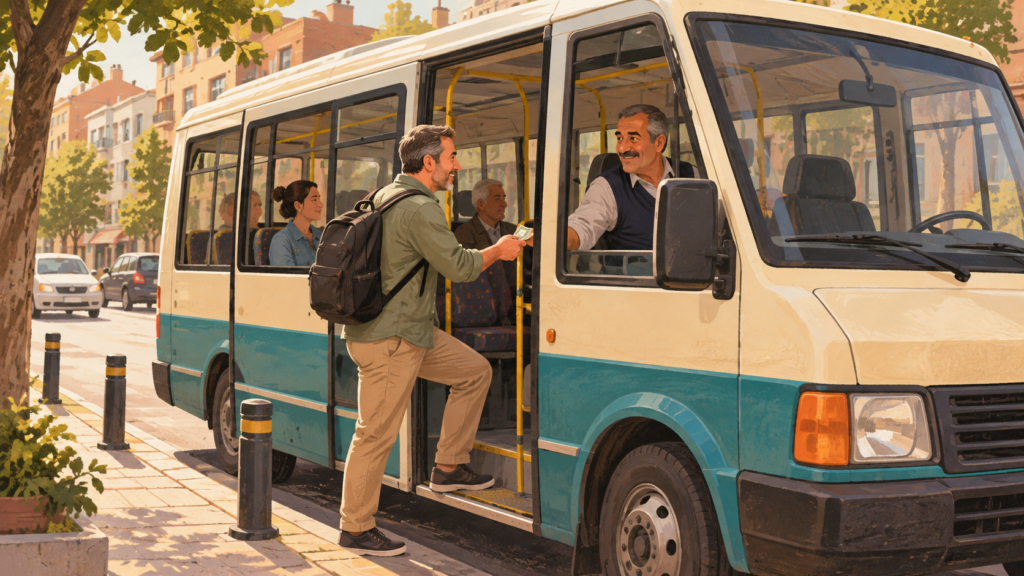
To ask the driver of a Turkish shared minibus (dolmuş) to pull over and let you off, say: "Müsait bir yerde inebilir miyim?" (moo-sah-EET beer yer-de ee-ne-bee-leer mee-yeem), which translates to "Can I get off at a convenient spot?" Getting around towns and cities in Turkey using shared minibuses is fast and affordable, but stepping on for the first time can feel overwhelming. Unlike municipal buses, a dolmuş rarely has fixed bus stop buttons or automated arrival announcements. You flag it down, pay in cash, and tell the driver when you want to get off. This guide gives you the essential phrases to board, pay, and alight with confidence, alongside broader Turkish language resources for everyday travel.
What Is a Dolmuş and How Does It Work?
The word dolmuş literally means "stuffed" or "filled," referring to the tradition of minibuses departing once passenger seats are occupied. While modern urban routes run on frequent schedules, the core system remains informal and direct.
You catch a dolmuş by standing on the roadside along its route and raising your hand. Destinations are displayed on signs behind the front windscreen. Because there are few formal stops along intermediate routes, drivers pull over whenever a passenger requests a stop or someone flags them down from the curb.
Boarding and Checking the Route
If you are unsure whether a minibus passes your destination, ask the driver before stepping aboard:
- "[Kadıköy]'e gidiyor mu?" (gee-dee-yor moo?) — Does this go to [Kadıköy]?
- "[Taksim]'den geçer mi?" (geh-CHEHR mee?) — Does this pass through [Taksim]?
Plausible driver replies include:
- "Evet, binin." — Yes, get in.
- "Geçer." — It passes [there].
- "Hayır, gitmiyor." — No, it does not go there.
Paying the Fare and Passing Cash Forward
Fares on a dolmuş are set by distance and paid directly in cash. On many minibuses, contactless card terminals are not available, so keeping small lira banknotes and coins ready is essential.
If you sit near the driver, you can hand your fare directly. If you sit toward the back row, passengers participate in a traditional cash relay: you hand your cash to the person in front of you, who passes it forward to the driver.
Useful payment phrases:
- "Bir kişi ne kadar?" (beer kee-shee ne kah-dar?) — How much for one person?
- "[Beşiktaş] bir kişi uzatır mısınız?" (oo-zah-TUHR muh-suh-nuhz) — Could you pass [fare for] one person to [Beşiktaş]?
When your change comes back down the line, the passenger handing it to you might say "Paranızın üstü" (Your change). You can simply reply "Teşekkür ederim" (Thank you).
Example Minibus Interaction
The following illustrative example shows how a typical minibus conversation unfolds from boarding to departure:
- Passenger (boarding): "Mecidiyeköy'den geçer mi?" (Does it pass through Mecidiyeköy?)
- Driver: "Geçer, buyrun." (It passes, come in.)
- Passenger (handing cash to front passenger): "Mecidiyeköy, bir kişi uzatır mısınız?" (Could you pass one fare for Mecidiyeköy?)
- Front Passenger: "Tabii." (Of course.)
- Passenger (approaching destination): "Müsait bir yerde inebilir miyim?" (Can I get off at a convenient spot?)
- Driver: "Tamamdır." (Alright.)
- Passenger (exiting): "Teşekkürler, kolay gelsin!" (Thank you, hope your work goes smoothly!)
- Driver: "Sağ olun!" (Thank you!)
What to Say When You Do Not Understand
If a driver or passenger speaks too quickly or you do not catch what was said, use these polite phrases to reset:
- "Afedersiniz, tekrar söyler misiniz?" (Excuse me, could you say that again?)
- "Pardon, anlamadım." (Sorry, I didn't understand.)
Practical Grammar: Asking Politely with -ebilir miyim?
The phrase inebilir miyim? uses a key Turkish grammar pattern for making polite permission requests.
- In-: The verb root meaning "to descend" or "to get off."
- -ebilir: The suffix indicating capability or possibility ("can" / "able to").
- miyim?: The first-person question ending ("may I?").
Combining them creates inebilir miyim? ("May I get off?"). You can apply this same pattern to other everyday verbs when asking for something politely:
- Alabilir miyim? (al- = take/buy) — May I have / take…?
- Bakar mısınız? — Excuse me / Would you look here? (Used to politely get attention).
Quick Practice Exercise
Test your memory with this brief scenario:
- You are seated in the middle row of a dolmuş and want the driver to know you want to get off near the upcoming junction. What is the standard polite phrase?
- You need to ask a passenger ahead to hand over your cash fare for one person to Kadıköy. What phrase do you use?
Check your answer:
- "Müsait bir yerde inebilir miyim?" (or informally "Müsait bir yer, kaptan!")
- "[Kadıköy] bir kişi uzatır mısınız?"
Next Steps
Navigating local transport in Turkish-speaking cities gives you instant freedom to explore beyond standard tourist hubs. Small, practical phrases built around real encounters help you feel comfortable in cafes, markets, and minibuses alike.
To keep building your everyday speaking skills with straightforward, scenario-based guidance, register your interest with PulseLingo.
Sources
- The Dolmuş Guide: How to Use Turkey's Shared Minibuses — Dolmuş shared minibus mechanics, cash payments, and route stopping flexibility in Turkish transit.
- How the Dolmuş Works in Alanya: A UK Visitor's Guide — Passing cash fares forward through passengers and hailing minibuses at roadside locations.
- Turkish Basics: Ten Expressions to Start and End Interactions — Everyday usage of 'Kolay gelsin' when leaving service workers and drivers.