
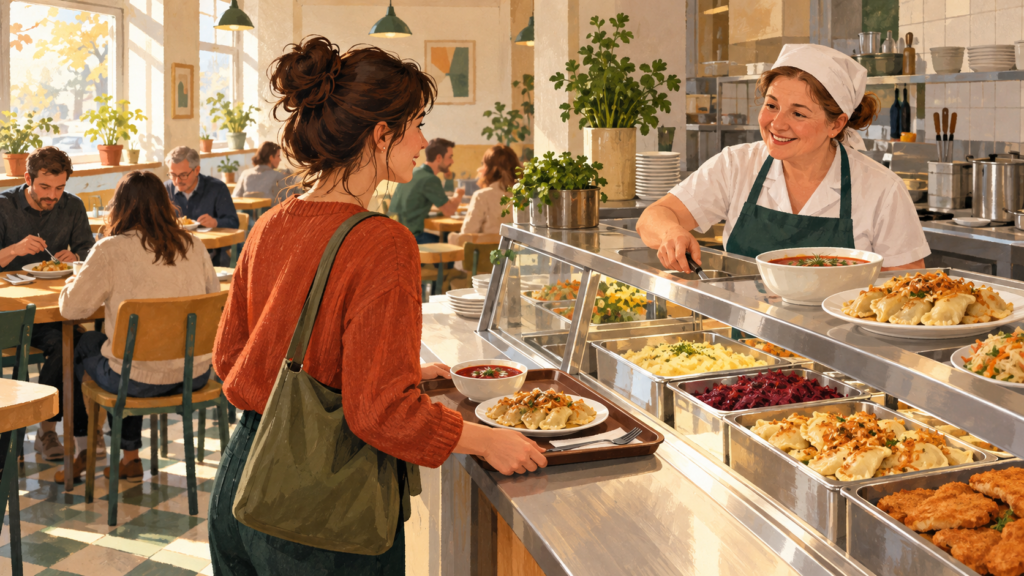
To order food quickly and politely at a Polish milk bar (bar mleczny) or cafeteria, start your request with Poproszę followed by your dish. For example, say Poproszę pierogi ruskie (I'll have potato and cheese dumplings, please) or Poproszę żurek (I'll have sour rye soup, please). Avoid starting orders with Chcę (I want), which can sound abrupt in Polish service settings.
At a fast-moving counter, staff usually follow a predictable sequence of questions. Knowing what to expect lets you answer confidently without getting overwhelmed.
The Four-Step Counter Sequence
When you step up to the register, the interaction generally follows four quick steps:
- Greeting and opening question
- Cashier: Dzień dobry! Co dla Pana? (Good day! What for you, sir?) or Co dla Pani? (What for you, ma'am?), or simply Słucham? (How can I help?)
- You: Dzień dobry. Poproszę zupę pomidorową. (Good day. I'll have tomato soup, please.)
- Dining location
- Cashier: Na miejscu czy na wynos? (Eat in or take away?)
- You: Na miejscu, dziękuję. (Eat in, thank you.) or Na wynos, proszę. (To go, please.)
- Drinks or extras
- Cashier: Coś do picia? (Anything to drink?)
- You: Kompot, proszę. (Compote, please.) or Dziękuję, to wszystko. (Thank you, that's all.)
- Payment method
- Cashier: Płatność kartą czy gotówką? (Payment by card or cash?)
- You: Kartą, proszę. (By card, please.) or Gotówką. (With cash.)
A Simple Grammar Rule for Ordering Foods
You do not need to master complex case endings before ordering your first meal. Just remember one easy rule for words ending in -a:
When you place a singular feminine item after Poproszę, change the final -a to -ę:
- zupa (soup) becomes zupę (Poproszę zupę)
- kawa (coffee) becomes kawę (Poproszę kawę)
- woda (water) becomes wodę (Poproszę wodę)
Plural nouns and masculine or neuter foods keep their basic form in this phrase:
- pierogi stay pierogi (Poproszę pierogi)
- żurek stays żurek (Poproszę żurek)
If you drop the -ę ending by accident, staff will still understand your order perfectly.
What to Say When the Cashier Speaks Quickly
Milk bar staff often speak fast during lunch rushes. If you miss a phrase or need them to repeat a question, use one of these polite recovery phrases:
- Przepraszam, czy może Pan powtórzyć? (Excuse me, could you repeat? — to a male staff member)
- Przepraszam, czy może Pani powtórzyć? (Excuse me, could you repeat? — to a female staff member)
- Wolniej, proszę. (Slower, please.)
Example Ordering Dialogue
Here is an example exchange at a counter. Prices in milk bars are modest; this entire order costs around 30 PLN (illustrative pricing):
- Staff: Dzień dobry, słucham?
- Learner: Dzień dobry! Poproszę zupę pomidorową i pierogi z mięsem.
- Staff: Na miejscu czy na wynos?
- Learner: Na miejscu.
- Staff: Coś do picia?
- Learner: Nie, dziękuję. To wszystko.
- Staff: Płatność kartą czy gotówką?
- Learner: Kartą, proszę.
- Staff: Razem 30 złotych. Proszę przyłożyć kartę.
- Learner: Dziękuję!
After eating, remember to return your tray to the dish collection window (odniesienie naczyń), as most milk bars are self-service.
Try It Yourself
Pause and test your recall without looking back at the lesson:
Question: How would you ask for a coffee to take away and state that you want to pay by card?
Answer: Poproszę kawę na wynos. Płatność kartą.
To build your confidence across more practical situation guides, explore our full collection on the PulseLingo Polish section. When you are ready to practice real conversational interactions step by step, register your interest with PulseLingo.
Sources
- At the Restaurant and Café | Polish Grammar | Elon.io — Establishes Poproszę as the natural polite ordering frame over Chcę, and Na miejscu czy na wynos as the standard question for eat in or take away.
- 50 Polish Phrases for Travel – Words on Repeat — Supports counter ordering in milk bars, changing feminine -a words like kawa to kawę after Poproszę, and general service interaction phrases.
- How do you say eating in or taking out? in Polish? – Memrise — Confirms na miejscu czy na wynos as the exact everyday phrase for eat in or take away.