
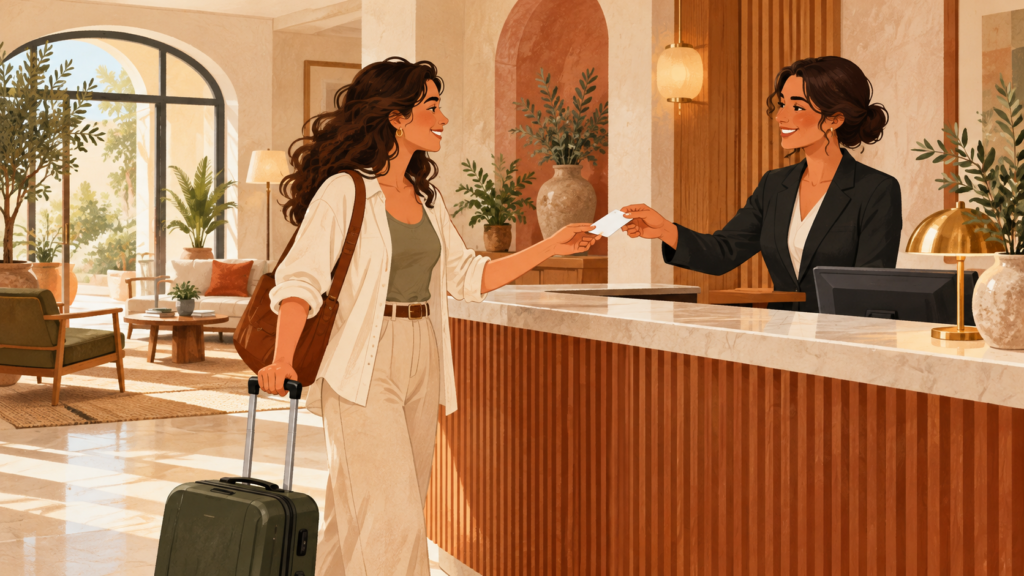
When checking into accommodation in Portugal, state your reservation clearly right after your greeting: "Boa tarde, tenho uma reserva em nome de [Your Name]." (Good afternoon, I have a reservation under the name [Your Name].) If you arrive in the morning, replace boa tarde with bom dia (good morning).
A Typical Front-Desk Exchange
Here is an example exchange showing how a standard hotel check-in unfolds at a reception desk in Portugal:
Receptionist: Boa tarde, seja bem-vindo! Como posso ajudar? (Good afternoon, welcome! How can I help?)
Guest: Boa tarde. Tenho uma reserva em nome de Taylor. (Good afternoon. I have a reservation under the name Taylor.)
Receptionist: Com certeza. Pode dar-me o seu passaporte, por favor? (Certainly. Could you give me your passport, please?)
Guest: Aqui está. A que horas é o pequeno-almoço? (Here it is. What time is breakfast?)
Receptionist: O pequeno-almoço é das sete às dez da manhã. Aqui tem o cartão do seu quarto, é o número 204 no segundo andar. O elevador fica à esquerda. (Breakfast is from 7 to 10 in the morning. Here is your room card, it is number 204 on the second floor. The elevator is on the left.)
Guest: Muito obrigado! Qual é a palavra-passe do Wi-Fi? (Thank you very much! What is the Wi-Fi password?)
Receptionist: Está escrita no envelope do cartão. Tenha uma boa estadia! (It is written on the card holder. Have a pleasant stay!)
Essential Hotel Vocabulary in Portugal
Notice how European Portuguese uses specific regional terminology that differs from Brazilian usage:
- O pequeno-almoço (Breakfast): In Portugal, breakfast is pequeno-almoço (unlike the Brazilian café da manhã).
- O cartão do quarto / A chave do quarto (Room key card / room key)
- A palavra-passe do Wi-Fi (Wi-Fi password): Palavra-passe is standard in European Portuguese for password.
- O elevador (The elevator)
- O primeiro / segundo / terceiro andar (The first / second / third floor)
- O documento de identificação / O passaporte (ID document / passport)
Asking for Repetition or Slower Speech
If the receptionist speaks too quickly or uses unfamiliar phrasing, use one of these clear recovery expressions:
- "Desculpe, pode falar mais devagar, por favor?" (Sorry, could you speak more slowly, please?)
- "Pode repetir, por favor?" (Could you repeat that, please?)
Self-Test: Practice Your Check-in
Try translating these three common hotel requests into European Portuguese before checking the answers below:
- I have a reservation under the name Silva.
- What time is breakfast?
- Where is the elevator?
Answers:
- Tenho uma reserva em nome de Silva.
- A que horas é o pequeno-almoço?
- Onde fica o elevador?
To build your practical vocabulary for travel and daily life across Portugal, explore our core European Portuguese essentials. To take your next step in speaking confident European Portuguese, register your interest with PulseLingo.
Sources
- How to Check-in at a Hotel in Portuguese! – YouTube (Talk the Streets) — European Portuguese hotel check-in phrases, showing ID, room keys, Wi-Fi password, and hotel interaction flow.
- How to Check Into a Hotel in Portuguese – YouTube (Learn Portuguese Today) — European Portuguese front desk vocabulary including 'pequeno-almoço' for breakfast, reservation phrasing, floor numbers, and elevator questions.