
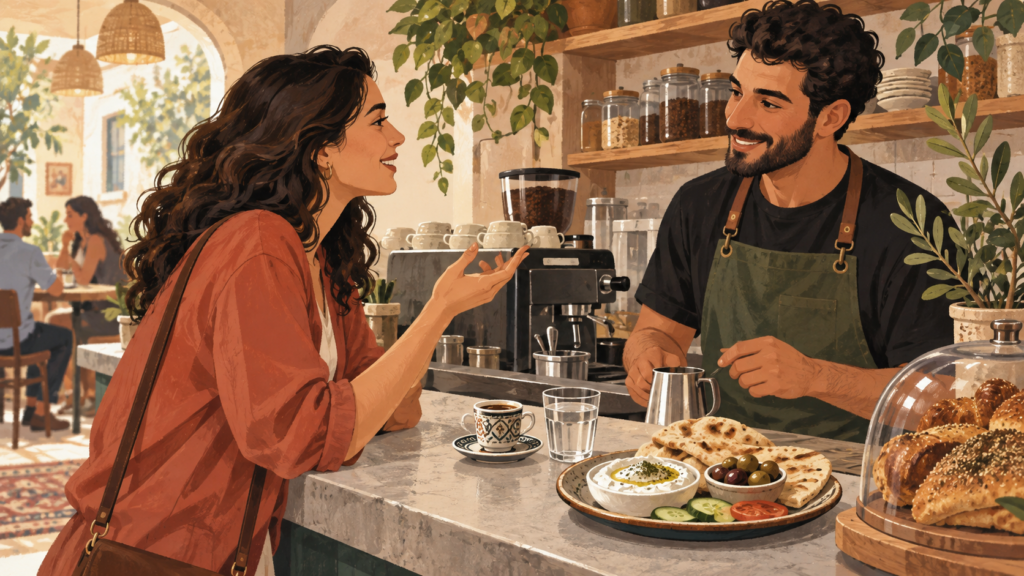
To order a coffee in Levantine Spoken Arabic (the everyday language used in Jordan, Lebanon, Palestine, and Syria), say Biddi 'ahwe, law samaht (بدي قهوة، لو سمحت) if addressing a male server, or law samahti (لو سمحتِ) for a female server. The phrase translates to "I would like a coffee, please." Unlike rigid textbook Arabic, using biddi is the most natural and courteous way to state what you want in daily cafe settings.
If you are building your conversational foundation for travel or daily interactions in the region, browse our Arabic section for practical dialect guidance.
Why "Biddi" Works Best in Levantine Cafes
Textbooks often teach the Modern Standard Arabic verb ureedu (أريد) for "I want." While every Arabic speaker understands it, using ureedu in a street cafe in Amman or Beirut can sound like reading from a formal document.
In everyday Levantine speech, biddi (بدي) combines the idea of wanting with the personal pronoun. It is direct without sounding demanding or rude. Adding law samaht ("if you please") keeps the interaction warm and polite.
In urban Levantine accents, the Arabic letter qaf (ق) in the word for coffee (qahwe / قهوة) is usually dropped and pronounced as a soft glottal stop. It sounds like 'ahwe rather than qahwe.
Customizing Your Coffee Order
Traditional Levantine coffee is brewed with finely ground beans and cardamom, served hot in small cups. Because sugar is added during the brewing process rather than stirred in afterward, you should specify your sweetening preference when you place the order.
- Bala sukkar (بلا سكر) – Without sugar (black/unsweetened)
- Sukkar khfeef (سكر خفيف) or 'Al-riha (على الريحة) – Very light sugar ("on the scent")
- Mazbout (مضبوط) – Medium sugar (balanced)
- Helwe (حلوة) – Sweet
- Ma' haleeb (مع حليب) – With milk
For example, if you prefer a coffee with milk and medium sugar, say: Biddi 'ahwe mazbout ma' haleeb, law samaht. (بدي قهوة مضبوط مع حليب، لو سمحت.)
Adding Food to Your Order
If you want a light breakfast or a savory bite with your drink, you can attach your food request directly using the same sentence structure.
- Manoushet za'tar (منقوشة زعتر) – Flatbread topped with wild thyme, sesame, and olive oil
- Manoushet jibneh (منقوشة جبنة) – Cheese flatbread
- Ka'ak (كعك) – Traditional sesame bread ring
To order both a coffee and a thyme flatbread, say: Biddi 'ahwe bala sukkar u manoushet za'tar. (بدي قهوة بلا سكر ومقوشة زعتر.)
Asking for the Bill
When you are ready to pay, catch the server's eye and use one of these standard expressions:
- El-hseb, law samaht (الحساب، لو سمحت) – The bill, please.
- Addeesh el-hseb? (قديش الحساب؟) – How much is the bill?
Servers frequently reply with tekram (تكرم) or 'ala rasi (على راسي), friendly expressions meaning "with pleasure" or "you are welcome."
Example Cafe Exchange
Here is an example of how a standard exchange unfolds at a local Levantine bakery or cafe:
Server: Marhaba! Shu biddak elyoom? (Hello! What would you like today?) Customer: Marhaba! Biddi 'ahwe mazbout u manoushet jibneh, law samaht. (Hello! I'd like a medium-sugar coffee and a cheese flatbread, please.) Server: Tekram. Ayya shee tani? (With pleasure. Anything else?) Customer: La, shukran. Addeesh el-hseb? (No, thank you. How much is the bill?) Server: Khams lirat. (Five dinars/pounds.) Customer: تفضل (Tafaddal – Here you go). Server: Shukran! (Thank you!)
How to Recover When Someone Speaks Too Fast
Cafe staff often speak quickly, especially during morning rushes. Rather than switching entirely back to English, keep these two steady recovery phrases ready:
- Shway shway, law samaht (شوي شوي، لو سمحت) – Slowly, please.
- Mumkin t'eed? (ممكن تعيد؟) – Could you repeat that?
Most staff appreciate the effort to speak Levantine Arabic and will happily slow down their speech.
Quick Self-Test
Try translating these two requests in your head before checking the answers below:
- How do you ask for a coffee without sugar, politely addressing a male server?
- How do you ask for the bill?
Answers:
- Biddi 'ahwe bala sukkar, law samaht. (بدي قهوة بلا سكر، لو سمحت.)
- El-hseb, law samaht or Addeesh el-hseb?
Next Steps in Your Arabic Learning
Mastering everyday transactions in spoken Levantine Arabic transforms simple coffee runs into rewarding cultural connections. To continue practicing high-frequency dialogue for real-life situations, register your interest with PulseLingo and start expanding your conversational skills.
Sources
- Learn Hardcore Arabic (Levantine): بدي قهوة. – I want coffee. — Establishes that 'biddi' (بدي) means 'I want' or 'I would like' in Levantine Arabic and is used naturally for coffee orders without needing subject pronouns like 'ana'.
- Beirut Café Arabic: What to Say When Ordering Coffee, Juice, and Breakfast — Supports Levantine cafe ordering expressions including 'Baddi ahwe, law samaht', sugar choices ('bala sukkar'), ordering breakfast items like za'tar manoushe, and asking for the bill ('El hseb, law samaht').
- Levantine Arabic survival phrases for travelers & expats – AlBaher Arabic Language Center — Supports Levantine greeting 'Marhaba', politeness markers 'min fadlak' and 'law samaht', and practical colloquial expressions.