
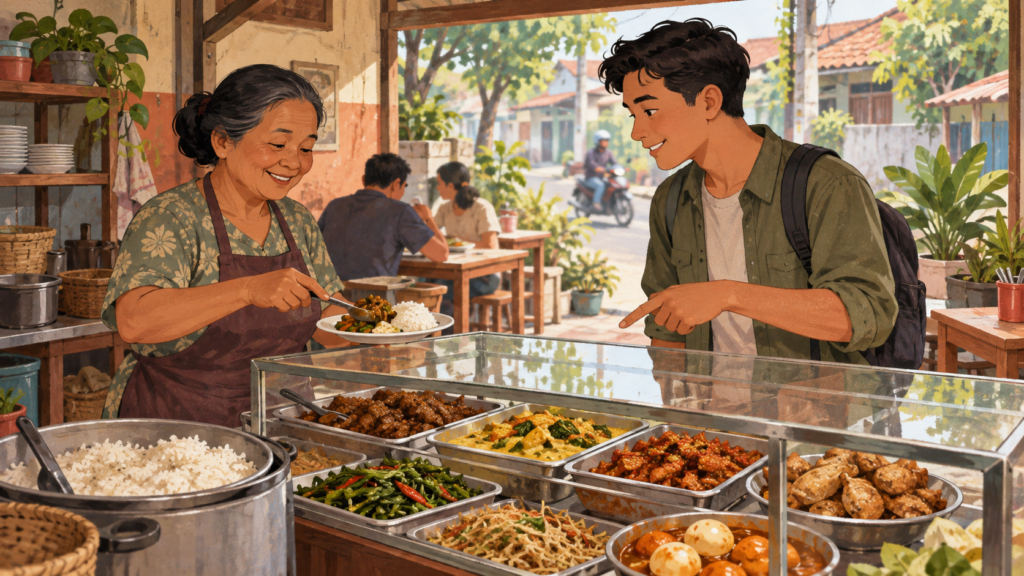
To order food at a local Indonesian eatery (warung), catch the server's attention politely with Mas (for a young man) or Mbak (for a young woman) and say "Saya mau pesan…" (I would like to order…). State whether you want to eat at the eatery with "makan di sini" or take your meal to go with "bungkus".
Core Phrases for Ordering
Indonesian sentence structure for ordering is straightforward. Place the dish name first, followed by the quantity:
- Saya mau pesan… — I would like to order…
- Nasi goreng satu, ya — One fried rice, please.
- Mie goreng dua — Two fried noodles.
- Makan di sini — Eat here (dine in).
- Bungkus (or bawa pulang) — Takeaway / to go.
- Berapa semuanya? — How much is it altogether?
Adding ya at the end of a request softens your tone and makes your speech sound natural and friendly.
Managing Spice Levels and Drinks
Indonesian food often comes with chili paste (sambal) integrated into the dish or served on the side. If you have a low tolerance for heat, adjust your order using these targeted phrases:
- Tidak pedas, ya — Not spicy, please.
- Pedas sedikit saja — Just a little bit spicy.
- Tanpa cabai — Without chili.
- Sambal pisah — Chili paste on the side (pisah means separate).
To order beverages, combine your drink choice with a quantity:
- Es teh manis — Sweet iced tea (the default iced tea across Indonesia).
- Es teh tawar — Unsweetened iced tea.
- Air putih — Plain drinking water.
Example Ordering Exchange
Here is a natural, short example exchange at a casual warung:
- Server (Mbak): "Selamat siang, mau pesan apa?" (Good afternoon, what would you like to order?)
- Learner: "Selamat siang, Mbak. Saya mau pesan nasi goreng ayam satu, ya." (Good afternoon. I'd like one chicken fried rice, please.)
- Server: "Makan di sini atau dibungkus?" (Eat here or takeaway?)
- Learner: "Makan di sini. Tolong tidak pedas, ya." (Eat here. Please make it not spicy.)
- Server: "Baik. Mau minum apa?" (Okay. What would you like to drink?)
- Learner: "Es teh manis satu." (One sweet iced tea.)
- Server: "Siap, tunggu sebentar, ya." (Got it, please wait a moment.)
- Learner: "Terima kasih, Mbak." (Thank you.)
Handling Fast Speech and Paying
If the server speaks quickly or asks something you do not understand, use a simple recovery phrase rather than switching to English:
- Maaf, tolong pelan-pelan — Sorry, please speak slowly.
- Bisa ulang? — Can you repeat that?
When you finish your meal, signal the server politely and ask for the total:
- Mbak, berapa semuanya? — Sister, how much is everything altogether?
- Boleh minta nota? — May I have the bill?
Self-Test: Construct Your Order
Imagine you walk into a warung in Yogyakarta. Try building this order in Indonesian before reading the answer below:
You want two portions of fried noodles (mie goreng) to take away, both made with only a little spice, and one plain water (air putih).
Answer: "Saya mau pesan mie goreng dua, bungkus, pedas sedikit. Sama air putih satu, ya."
Next Steps in Indonesian
Practicing these practical phrases gives you immediate confidence when eating at local food stalls across Indonesia. To explore more essential vocabulary and everyday travel phrases, visit the Indonesian learning hub. If you want to follow PulseLingo's development and updates, you can register your interest with PulseLingo.
Sources
- How to order food in Indonesian – phrases, dialogues, and tips – Preply — Phrases for ordering food at a warung, specifying takeaway (bungkus) or dine-in (makan di sini), and asking for reduced spice level.
- Reading an Indonesian menu: nasi, mie, goreng, bakar and how to ask for less heat – Foreigndly — Addressing servers with Mas or Mbak, placing quantities after dishes, and asking 'Berapa semuanya?' for the total bill.
- How do you say takeaway or eat here in Indonesian? – Talkpal AI — Distinction between 'makan di sini' (eat here) and 'bungkus' (takeaway) in Indonesian eateries.