
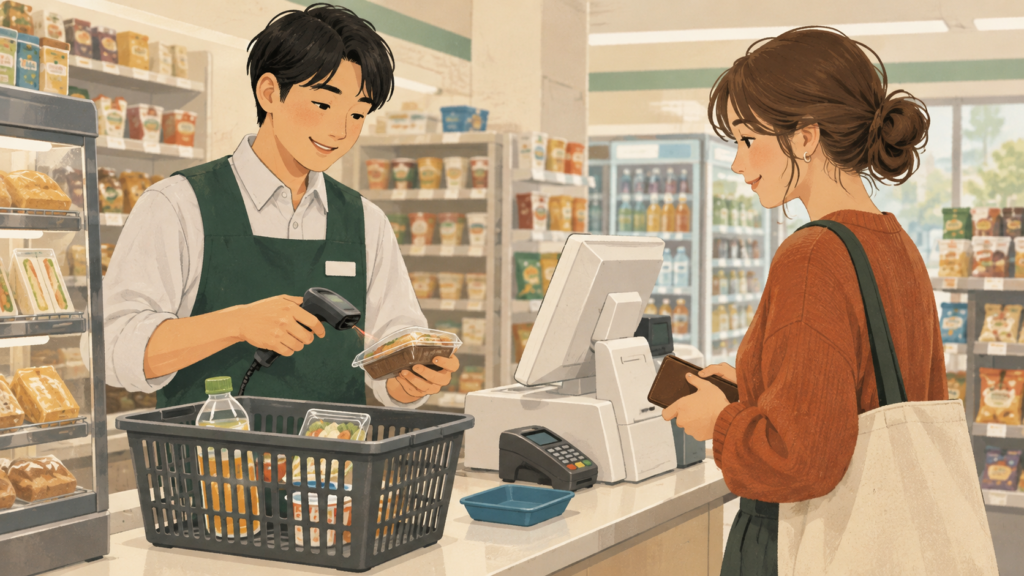
What Cashiers Ask at Japanese Convenience Stores
Walking up to a Japanese convenience store (konbini) register can feel like rapid-fire questioning, but cashiers across major chains like 7-Eleven, Lawson, and FamilyMart follow a predictable script. You do not need to understand every formal word they say. Instead, listen for four core keywords and reply with two simple, natural responses: Hai, onegaishimasu (Yes, please) or Iie, daijōbu desu (No, I’m okay).
Recognizing these key sound cues allows you to complete transactions smoothly without guessing or feeling rushed.
The 4 Questions You Will Hear at Checkout
Cashiers use polite service language (keigo), which makes full sentences sound long and formal. Focusing on the main keyword in each question tells you exactly what they are asking.
- Bag request:
- What you hear: Fukuro wa irimasu ka? (袋はいりますか?) or Fukuro wa go-riyō desu ka? (袋はご利用ですか?)
- Keyword cue: Fukuro (袋 / bag).
- Meaning: “Do you need a bag?” Plastic bags carry a small fee (usually 3–5 yen) in Japan, so cashiers always confirm first.
- Heating up food:
- What you hear: O-bentō, atatamemasu ka? (お弁当、温めますか?)
- Keyword cue: Atatame (温め / heat up).
- Meaning: “Should I heat up your bento or meal?” If you purchase a lunchbox, pasta, or prepared meal, the clerk offers to microwave it immediately behind the counter.
- Utensils:
- What you hear: O-hashi wa o-tsuke shimasu ka? (お箸はお付けしますか?)
- Keyword cue: O-hashi (お箸 / chopsticks), supūn (スプーン / spoon), or fōku (フォーク / fork).
- Meaning: “Would you like chopsticks or eating utensils?”
- Point cards:
- What you hear: Pointo kādo wa o-mochi desu ka? (ポイントカードはお持ちですか?)
- Keyword cue: Pointo kādo (ポイントカード / point card).
- Meaning: “Do you have a loyalty point card?”
Master the Two Essential Responses
You do not need complex grammar to answer cashiers politely. Sticking to two clear expressions covers almost every situation.
- When you want the item or service: Say Hai, onegaishimasu (はい、お願いします / Yes, please).
- When you do not need it: Say Iie, daijōbu desu (いいえ、大丈夫です / No, I’m okay).
While many travelers use daijōbu desu for everything, adding a clear Hai (Yes) or Iie (No) at the start prevents any misunderstanding. If you prefer to be even more direct when declining a plastic bag or spoon, you can also say Irimasen (いりません / I don’t need one) with a polite nod.
An Example Checkout Interaction
Here is an example exchange showing how a typical checkout conversation flows at the register.
- Cashier: Irasshaimase! Fukuro wa irimasu ka? (Welcome! Do you need a bag?)
- You: Iie, daijōbu desu. (No, I’m okay.)
- Cashier: O-bentō, atatamemasu ka? (Should I heat up your bento?)
- You: Hai, onegaishimasu. (Yes, please.)
- Cashier: O-hashi wa o-tsuke shimasu ka? (Would you like chopsticks?)
- You: Hai, onegaishimasu. (Yes, please.)
How to Recover When You Do Not Understand
If a cashier asks something you did not catch, do not panic. Use these simple recovery phrases to ask for repetition or clarification:
- To ask them to repeat: Mō ichido onegaishimasu (もう一度お願いします / Once more, please).
- To ask them to speak slower: Mō sukoshi yukkuri onegaishimasu (もう少しゆっくりお願いします / A little slower, please).
If you are still unsure, gesturing to your own tote bag or pointing to the item on the counter will usually help the cashier understand your intent right away.
Quick Practice: Test Your Konbini Readiness
Read each cashier question below, cover the answer, and decide how you would respond in Japanese:
- The cashier points to your cold pasta dish and says: “O-bentō, atatamemasu ka?”
- Goal: You want it warmed up.
- Your response: Hai, onegaishimasu.
- The cashier holds up a plastic bag and says: “Fukuro wa irimasu ka?”
- Goal: You brought your own backpack and do not need a bag.
- Your response: Iie, daijōbu desu.
- The cashier holds a pair of chopsticks and says: “O-hashi wa o-tsuke shimasu ka?”
- Goal: You need chopsticks to eat your lunch.
- Your response: Hai, onegaishimasu.
Building confidence in daily Japanese starts with small, successful interactions like these. You can explore more situational lessons and practical tools on our Japanese learning hub. When you are ready to expand your conversation skills further, consider registering your interest with PulseLingo to discover new ways to practice real-world language skills.